
Fingal Poetry Festival wishes to thank all the poets from around the world who submitted their poems this year. We are delighted with the response! Go raibh míle maith agaibh!
The three winners of the Fingal Poetry Prize are:
- Damen O’Brien, “The Most Wished For”
- Kate Durrant, “The night you died”
- Lizzie Ballagher, “Cave Hill, 1971”
Congratulations! Read the three winning poems on this page.
And the three winners of An Fiach Dubh Comórtas Filíochta: The Irish Language Poetry Competition are:
- Sa chéad áit: Caitríona Ní Laighin, “Bróg an pháiste saonta”
- Sa dara háit: Áine Ní Ghlinn, “Teifeach”
- Sa triú háit: Máire Dinny Wren, “Féileacán Fómhair”
Comhghairdeachas leo! Congratulations! Their poems are available for you to read here.
Damen O’Brien, “The Most Wished For”
1st Place, Fingal Poetry Prize 2024.
All you can speak about is the unicorns. All anybody
ever talks about are the unicorns: will there be enough
rain to save them? Will the cellophane horizon, scribbled
smoky with the angry skywriting of the bushfire’s heartbreak
cleanse into rinsing? Will the crumbling grass, stiff as a
fist of crisp spaghetti, be enough to feed the gaunt remains
of the herd? Enough to make mares’ milk for the late foals
nudging at the empty glass of their mothers? All you can
talk about is the day you saw the ragged line of unicorns
being taken to the abattoirs because the farmers could not
feed them and you blink back tears in the telling. All anyone
can talk about is those dumb animals, this unseasonal failure
of rain and the mournful convoy of water trucks which
file their long hose into town and replenish the reservoir.
Unicorns, not people. Not the dry problems of people.
When you were young, like other little girls you drew your
stick unicorns with obsessive crayons, all isosceles horns,
circles for eyes, the tail a straight line leaving the page.
Unicorn backpack, unicorn shirt. Plush and stuffing animals
crowding your bed. You never lost that uncritical love,
so we bought this place – fixer-upper and derelict charm –
because a farm that runs unicorns was nearby. You wanted
to see the unicorns, though there was more work for me
back home. We decorated that second room with the motif
of your life, with the blank glass stares of cuddle-soft
unicorns, rearing mobiles, silhouette lamps and rugs.
But now you hide in this sorrow for unicorns and will
not talk to me of anything important: that empty room
with its pink prints, the occasional echo of hooves
in our dreams. We should talk about how rare happiness is,
how unnecessary horns are. We should talk, my love,
of other things. How this house is too quiet for just two
of us and how we should stop believing in unicorns.
Kate Durrant, “The night you died”
2nd Place, Fingal Poetry Prize 2024
The night you died
I learnt that the crescent moon hangs differently in the dark Mallorcan sky
as if from one hook when two were needed.
If you were here I would ask you why,
and you would reply
by mapping shivery shapes on my forearm with your finger,
or maybe
just to touch me.
I learnt that Spanish paramedics drive slowly,
almost, fittingly, hearse-like.
Leaving trails of softly pulsing blue light behind them
in the reflection of sleeping shop windows.
The gnarled branches of the slowly waking olive trees
waving you onwards towards your final destination
as we pass.
I learnt the common language of death which makes small talk impossible,
yet fluently opens those doors
that silently allow cooling bodies to slide through them to the other side;
granting access to the dark family room that smells of sorrow and tastes of tears
and is available,
only,
to those who now have no family.
I learnt that when the detritus of age and illness
was gently sponged from your ravaged body,
nurses with soft hands and warm soapy water would restore you,
respectfully rinsing away the indignity
of living too long.
The night you died,
the night that the illness that had been stealthily stealing you away,
memory by memory,
dared to come back for your body,
I learnt that under the badly hung crescent moon and within the Spanish silence,
I could
nearly
hear you
say goodbye.
Lizzie Ballagher, “Cave Hill, 1971”
3rd Place, Fingal Poetry Prize 2024
Barely a breath of wind to stir the heather.
Treeless tracks were empty, but for us.
For once: no rain in Belfast—
not in many weeks: the long drag of Crumlin Road
grained with grit and, indoors, all open windows
inadequate to cool the blood of paramilitaries
or soldiers in the cauldron city.
We needed an escape: to turn our backs,
lean in to cool, to calm.
To quit the roar of protests,
sirens, marches, bombs:
leave all of it behind.
It might have been madness,
but we scrambled the hill’s flanks
where it lay like a craggy beast, sweltering
in mid-day sun. Basalt radiated
furious heat into the day’s drought….
At last, to the rocky table-top, to the sweep
of a sultry Lough Neagh beyond the sprawl
of dolls’ houses far below, where conflict
seemed displaced, distant, even absent:
not a thing that had to do with us.
Eating last year’s wizened apples, we sat
in breathless dust until evening’s cloud-pall lifted;
till air grew chilled—sun dropping
in the slow, gold west.
Then turned to home.
Our fastest route was treacherous:
down shadowed scree, with scrubby thorn-trees,
limestone chips that gave no mercy to bare shins.
Then Belfast’s din rose up again
from squares and bars below: those shouts,
those warning shots, reports; that bitter anger
glaring, rearing up toward us. Stones cut through
our sandals. Thorns gouged our legs. Drew blood.
We’d sooner have rested on the ancient hill
with caves and the bones of another history.
Treeless tracks were empty, but for us.
Barely a breath of wind to stir the heather.
Our judge: Peter Sirr
As part of the 2024 Fingal Poetry Festival, September 13th – 15th 2024, this year’s Fingal Poetry Prize was judged by Peter Sirr.
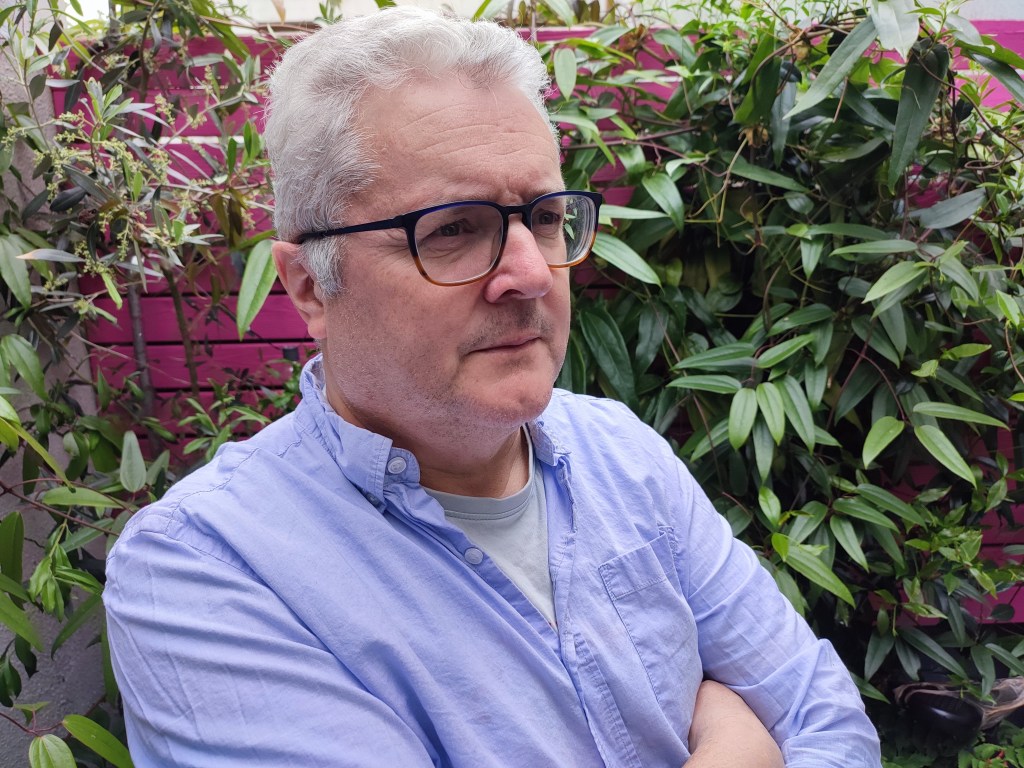
Peter Sirr lives in Dublin. The Gallery Press has published his eleven poetry collections since Marginal Zones (1984), most recently The Swerve (2023) and The Gravity Wave(2019) which was a Poetry Society Recommendation and winner of the 2020 Farmgate Café National Poetry Award. In his essays, Intimate City (2020), he takes us wandering through the streets of Dublin, past and present, tracing old routes and discovering new ones. He has won many awards for his work including the O’Shaughnessy Award for Poetry, the Patrick Kavanagh Award, the Eamon Keane Award at Listowel Writers’ Week and the Michael Hartnett Award. He’s written plays for radio, a children’s book and criticism. He teaches literary translation in Trinity College and has led many workshops and mentoring sessions and is a member of Aosdána.
Our sponsors are once more DHL. Thank you!

We very much hope to be able to meet you in Skerries at our festival in September.
- The competition was open for entries from 1 May to 30 June 2024. It is now closed.
Rules
- Open to national and international entrants aged 18 or older, poems must be in English and not exceed 40 lines, must be the original work of a living writer and must not have been previously published, self-published, broadcast, awarded or have appeared anywhere online.
- Poems must be typed clearly. The name and contact details of the entrant must not appear on the poems but must instead be entered on the official entry form, along with the poems’ titles and first lines.
- NB: Your poem(s) must be in PDF or Word format. No other formats will be accepted.
- The judge’s decision is final and no correspondence will be entered into.
- Poems will not be returned and no alterations may be made to poems once they are submitted.
- Copyright of the winning poems will remain with the author but Fingal Poetry Festival reserves the right to arrange first publication or broadcast for the purposes of the festival.
- We will acknowledge receipt of your entries. Please make sure to check spam or junk folders. Successful poets will be notified in advance of the festival dates in September.
- We hope to invite the authors of the three winning entries to an awards ceremony in Skerries on Saturday, September 14th, 2024.
See also our FAQs below.
FAQs
1: Can I make changes to my poem after it has been submitted?
No. Alterations cannot be made after you have submitted your entry so please check to ensure you are sending the correct version of the poem/s you want considered for the prize. If however, you want to submit an altered or new version, you may only send it as another, separate entry, which will then incur another entry fee. The judge will read and consider both entries.
2: I have inadvertently left identifying details (name etc.) on my poem/s, will my entry be disqualified?
Yes. However, if you find that you have done this in error, please resubmit your amended entry as soon as possible (at the latest by the end of the competition, 30 June 2024).
3: Are simultaneous submissions allowed?
Yes, although we strongly recommend against it. If, however, you do wish to send your poem/s to a journal or another competition, you must contact us immediately in the event of your poem/s being accepted there or shortlisted/placed. Your poem/poems will then have to be withdrawn from our completion and your entry fee cannot be refunded.
4: Can I enter by Post?
No. Entries can only be submitted through our online portal.
 Fingal Poetry Festival